
I. The Messenger of Artemis
Its scientific name, Artemisia, binds it inseparably to the Greek goddess of the moon and the hunt. Artemis, patroness of women and childbirth, is said to have revealed the virtues of this plant to mortals herself. In Antiquity, care of the body was not separated from protection of the soul: mugwort treated menstrual pain and soothed fevers, but it was also worn as an amulet against the evil eye.
Celtic folklore gives it an even more mysterious role. On the Isle of Man, people carried a branch of mugwort on Tynwald Day to ward off evil spirits. Across the British Isles, herbalists slipped it into protective sachets, convinced that its pungent scent cut through the veil between the visible and invisible. The Romans took a more down-to-earth approach: they planted mugwort along roadsides so that exhausted travellers could slip it into their shoes and soothe their aching feet. Yet even this practical gesture concealed an older belief: mugwort opened passages, whether physical or spiritual.
On the other side of the Atlantic, the Indigenous peoples of North America called it the “dream plant.” They dried its leaves, burned them as incense, or stuffed them into pillows, convinced that it helped them remember dreams and travel between worlds in the middle of the night. For this is the very heart of mugwort: it does not merely heal the body; it opens doors.
II. Gathering the Invisible
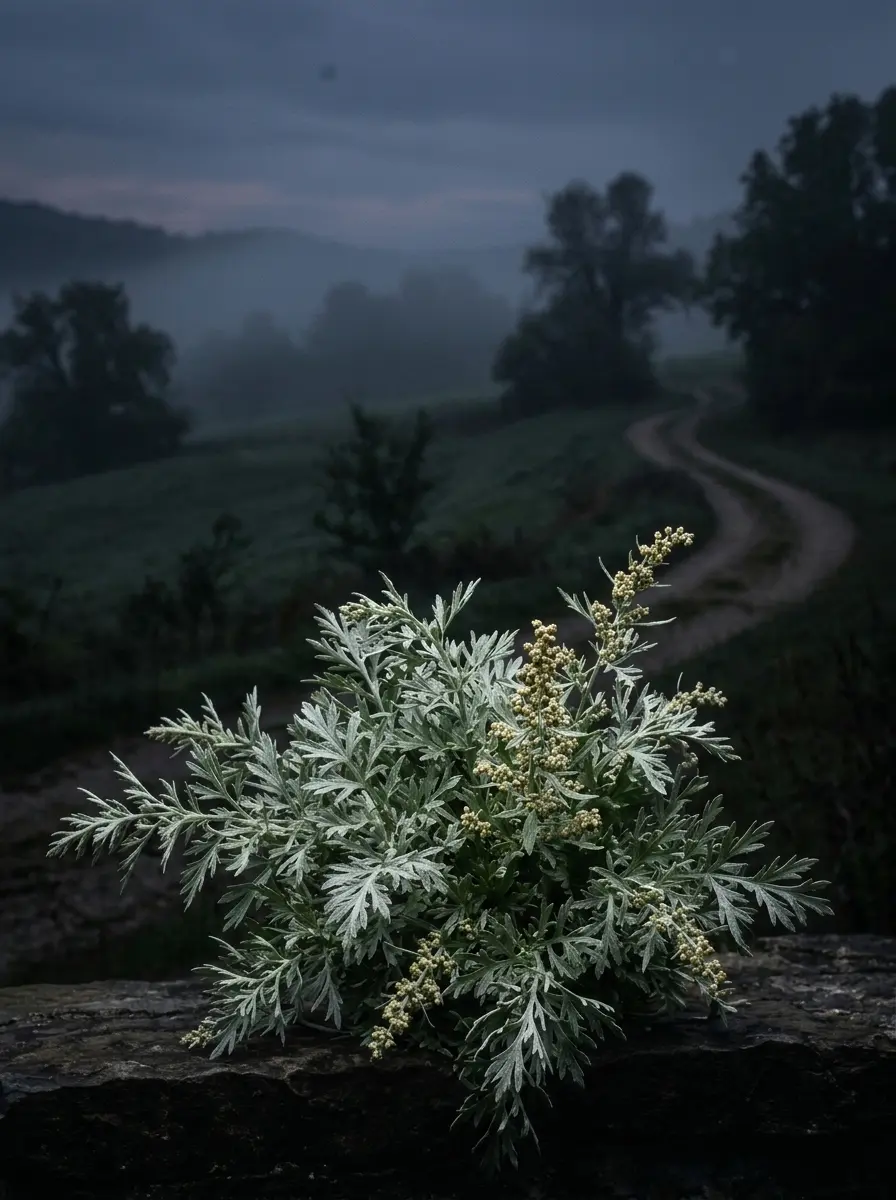
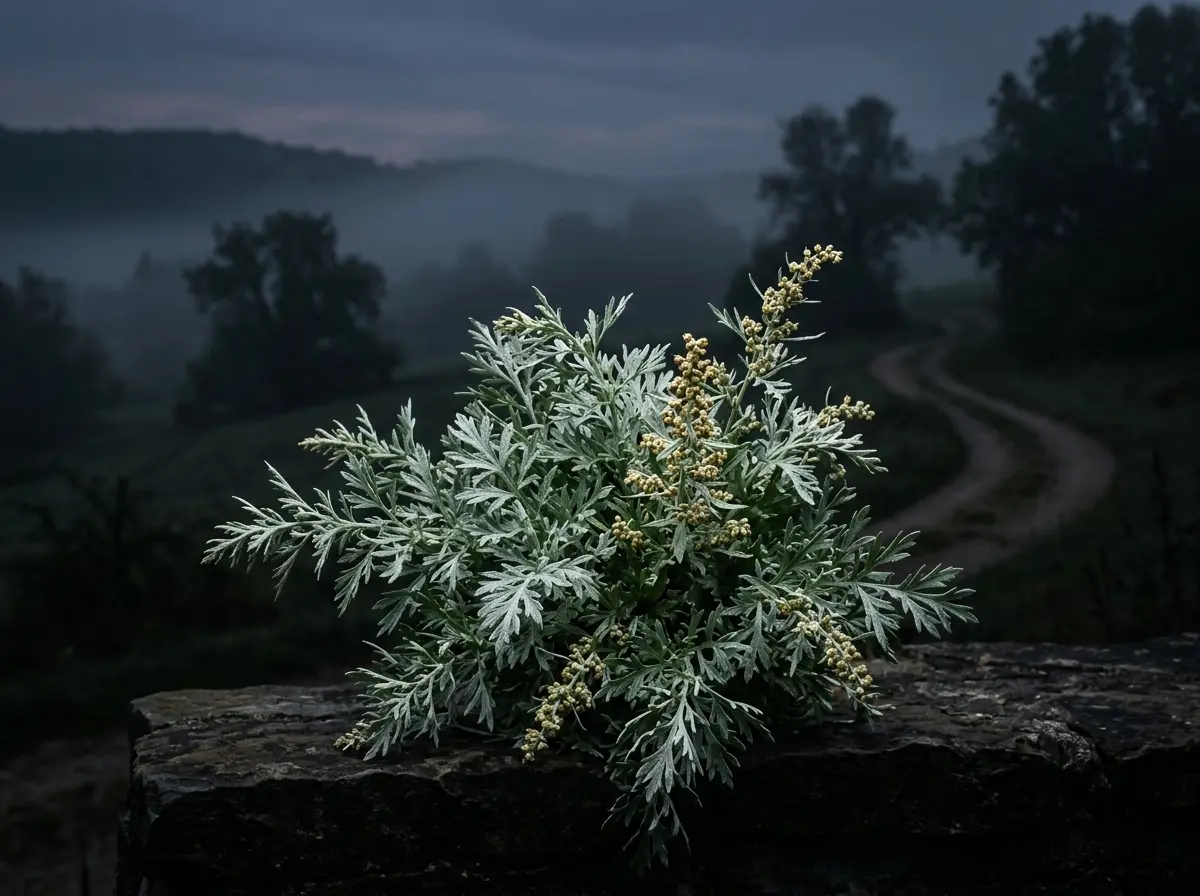
Common mugwort (Artemisia vulgaris) can be recognized by its silvery leaves, almost white underneath, and by the camphor-like scent that rises to the head as soon as a leaf is crushed between the fingers. The harvest depends on how you intend to use it. For teas and infusions, choose the flowering tops in midsummer, when the tiny yellowish buds begin to open. For dream pillows and sachets, gather the leaves in spring, before flowering, when they contain the highest concentration of essential oils.
Once gathered, the stems dry quickly in the shade, in a well-ventilated place, suspended in small bundles or spread on drying racks. Mugwort does not like direct sunlight: its active constituents evaporate under excessive heat. After about ten days, the leaves break between the fingers like silver paper. Store them afterward in opaque glass jars, away from light.
Here is a simple preparation for exploring the world of dreams:
- Gather a handful of dried mugwort leaves.
- Mix them with a handful of lavender and a handful of linden flowers.
- Stuff the mixture into a small natural cotton pillowcase.
- Place it beneath your pillow before falling asleep, breathing its fragrance deeply.
This dream pillow, used for centuries in shamanic and folk traditions, does not promise prophetic visions, but it invites a deeper night, one more attentive to what the unconscious has to say. As a tea, a handful of leaves steeped for ten minutes in a cup of boiling water aids digestion and calms the nerves. Be careful, however: mugwort is not recommended for pregnant women.

Vervain — Herbarium of dreams
Keep plant seasons and secrets close at hand.
Harvests, preparations, and botanical stories accompany you from the forest to your pillow.
III. The Herb of the Apocalypse and Awakening
In the Book of Revelation, a star named Wormwood falls from the sky and poisons one-third of the Earth’s waters. This name is no coincidence: Artemisia absinthium, common wormwood, is the bitterest of all herbs. Yet that very bitterness made it a precious remedy. Hildegard of Bingen, the twelfth-century mystic, proclaimed it “the most important master against all exhaustions.” Hippocrates prescribed it for menstrual pain and rheumatism. The Egyptians had already recorded it in the Ebers Papyrus more than three thousand five hundred years ago.
Mugwort embodies this fundamental duality of herbalism: what heals can also poison, and what soothes can also excite. Absinthe, the green drink of nineteenth-century poets and painters, is its troubling proof. It was called the Green Fairy, and it swept more than one overly fervent artist into its dance. But mugwort itself is not guilty: dose, preparation, and respect make the difference between remedy and poison.
For the modern herbalist, mugwort is an essential reminder: the plant is not a simple molecule to be extracted, but a complex entity carrying stories, precautions, and mysteries. Learning to know it means learning to listen. And in a world that moves ever faster, mugwort invites us to slow down, close our eyes, and cross the passage toward what our dreams are trying to tell us.
An article written for those who know that true wisdom is gathered between waking and sleep.
Selected references
Szopa, A., et al. (2020).
Artemisia absinthium L.—Importance in the History of Medicine and the Current State of Knowledge About This Species
. PMC / National Center for Biotechnology Information. A historical analysis of wormwood, from Antiquity to Hildegard of Bingen, and its modern biological properties.
MDPI, Pharmaceuticals (2025).
The Historical Role of Wormwood and Absinthe in Infectious Diseases: A Narrative Review and Future Perspectives
. A review of wormwood’s medicinal uses from the Ebers Papyrus — 1550 BC — to its colonial and pharmaceutical applications.
Wild Rose College (2024).
Mugwort: History, Magic and Dream Oil Recipe. A presentation of common mugwort in Celtic folklore, its protective uses, and its role in dreamwork.
Following Deer Creek (2018).
Mugwort — Dream Plant with a Long History. A history of mugwort linked to the goddess Artemis, Roman traditions, and Indigenous American uses as a “dream plant.”
Mecklenburgh Square Garden (2020). Artemisia absinthium: the Bohemian. A cultural exploration of wormwood, from biblical references to Shakespeare and the legend of absinthe.
Wikipedia.
Artemisia absinthium — Cultural history. A reference on the star Wormwood in Revelation, the name Chernobyl, and quotations from Lucretius and Nicholas Culpeper.