
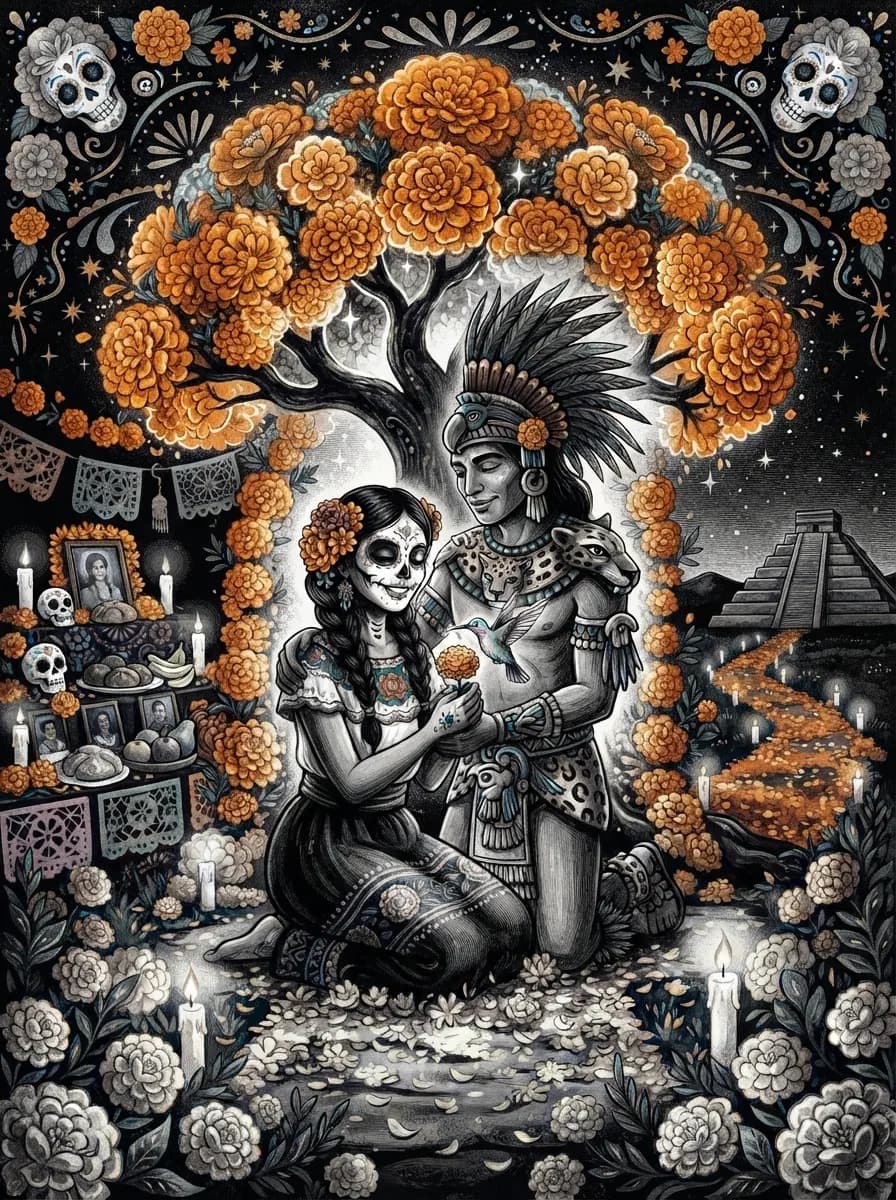
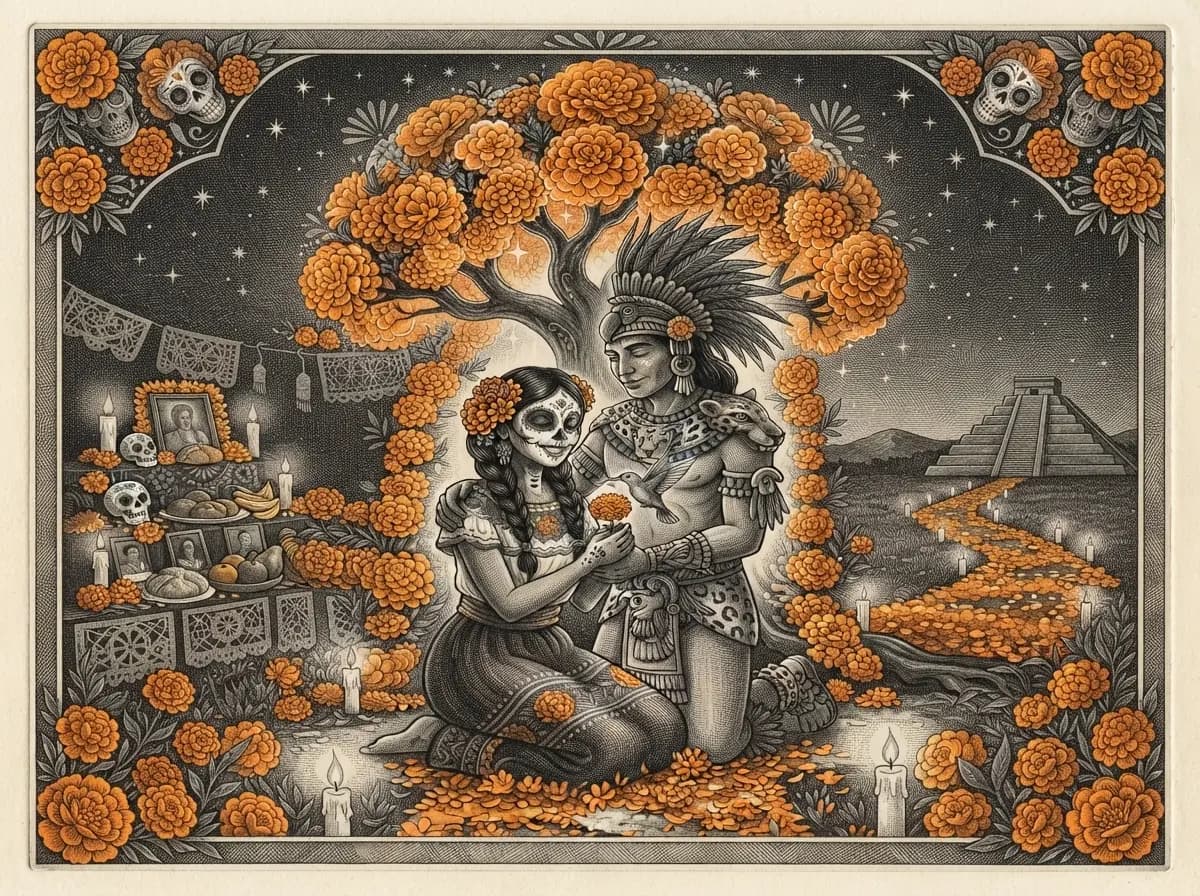
Every year, as autumn warms Mexico in shades of orange, a radiant flower rises as though to remind us that death is not the end of all things. Cempasúchil (Tagetes erecta), known as flor de muertos—the flower of the dead—is far more than an ornamental plant. Its color and fragrance trace a bridge between two worlds, a path that souls may follow to find the living once more. [1]
A flower born of a love death could not divide
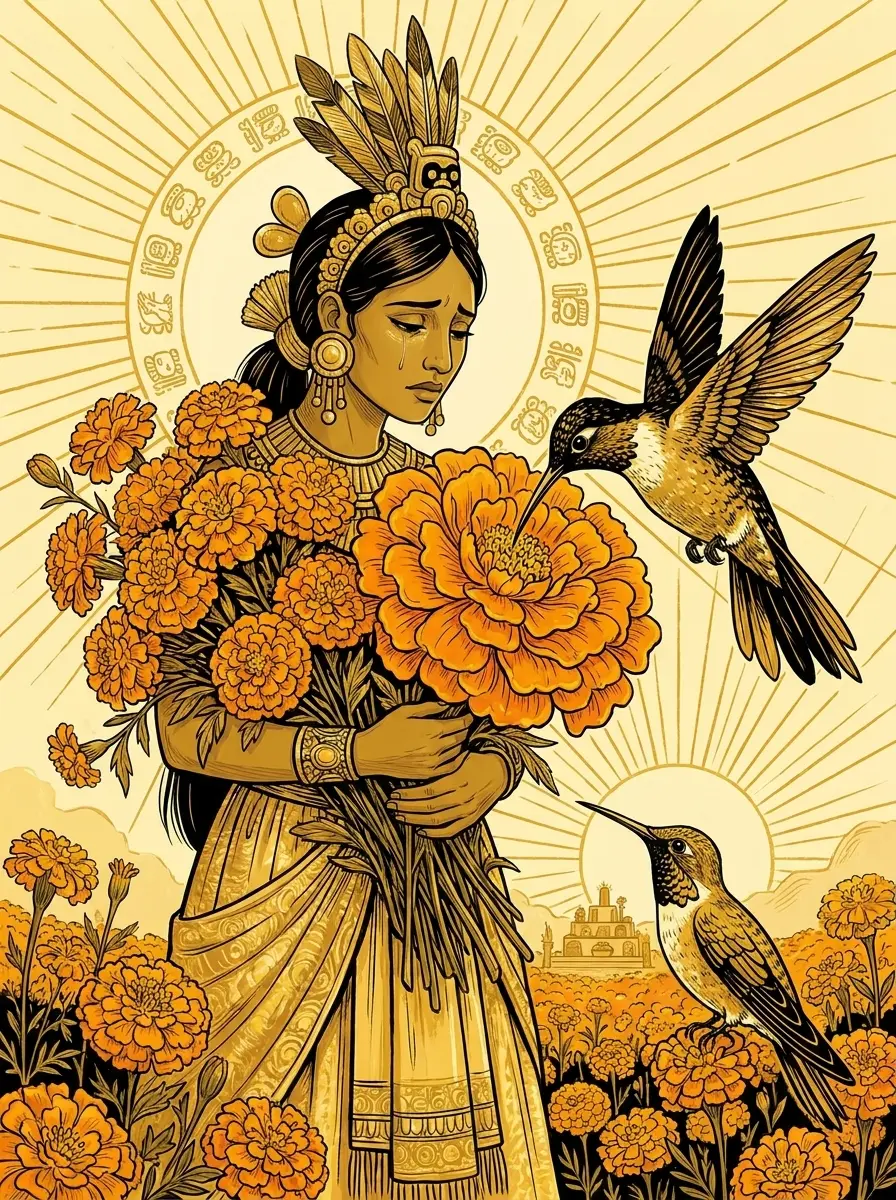
Legend tells that Xóchitl and Huitzilin had loved one another since childhood. Together, they climbed the mountain to offer flowers to Tonatiuh, the sun god, and ask him to protect their love. But war took Huitzilin away. Left alone, Xóchitl returned to the god and begged him to reunite her with the one she loved.
Moved by her sorrow, Tonatiuh transformed her into a flower the color of the sun. Its petals remained closed until the day a hummingbird came to rest upon it. The flower then opened, releasing its fragrance: Huitzilin had returned in a new form. As long as cempasúchil flowers bloom and hummingbirds come to visit them, their love will continue to cross the boundary of death. [2]
This story carries within it the spirit of Día de Muertos, celebrated in early November. It is not about erasing grief, but welcoming back those who are no longer here. Families build ofrendas laden with photographs, candles, food, and cherished objects. The celebration unites Indigenous rites dedicated to the dead with the Catholic observances brought to Mexico. [3]
I. The Golden Wake and the Weave of Shadows
It is no accident that this flower traces a path through the night. If cempasúchil crosses the darkened veil, it is because it embodies the afterglow of primordial fire. Its orange is not a color, but a ray made fast: a tangible memory of the star that has vanished beneath the horizon. Its fragrance, a volatile essence, is not merely an olfactory signal; it is an ethereal Ariadne's thread weaving an analogy between ash and flame. The soul, in its subtlety, does not follow a scent; it is polarized by this solar resonance, which points the way toward its own origin, from the entrance of the earthly dwelling to the altar, reflection of the celestial abode. [1] [4]
Learn herbalism with Vervain.
Download the app
Around the effigies, the flower embraces the light of candles; in the necropolises, it becomes arch and gateway. In Mixquic as along the shores of Lake Pátzcuaro, darkness then grows heavy with presence. Grief is not denied through hollow consolation, but transmuted into conjunction: the absent one becomes an invisible guest, and separation a mere stretching of space-time.
Its Nahuatl name—cempohualxóchitl—means “twenty flowers” or “many flowers.” In a symbolic reading, this profusion becomes the image of a cyclical totality, a fulfillment. Before syncretism diminished its meaning, the Ancients of Mexico already recognized in this plant the solar tincture required for the final journey, a vegetal key opening the gate to the Mictlans. [1] [5]
II. From the Nourishment of the Dead to the Medicine of the Living: One and the Same Tincture
The herb that guides the shadows also distills its virtues into bodies of flesh. In traditional herbalism, it cleanses the digestive humors, soothes colic, and revives a languishing appetite. These uses do not belong to an ordinary pharmacopoeia, but to an analogical medicine: the same solar warmth that illuminates the soul's night dissolves the obstructions and cold winds of matter. [6]
Modernity, in its reductive chemistry, isolates lutein and flavonoids within its petals. It sees in them antioxidants and anti-inflammatory compounds. [7]
Studies on wound healing merely rediscover, in another language, the power to reunite torn tissues, an operation akin to the one that weaves the bond between the living and the dead. Yet beware: the concentration of the laboratory no longer bears any resemblance to domestic magic; applying the raw flower to a wound is like trying to capture the sun with a mirror. [8]
III. Ritual Manducation and the Second Light
That this flower should find its way onto the plate, mingled with breads, sauces, and beverages, is no decorative fancy. It is the ultimate fulfillment of its cycle: to incorporate the ray. From funerary offering to festive manducation, the flower accomplishes the same syzygy: it does not color by chance, but imbues matter with a presence. It does not deny death; it sets against it an obstinate orange presence that consumes the shadow without destroying it, making every meal a solar Eucharist and every memory a living eternity. [9] [10]
Sources and references
Secretaría de Agricultura y Desarrollo Rural, Government of Mexico.
Flor de cempasúchil, belleza, esencia y tradición.
Servicio de Información Agroalimentaria y Pesquera, Government of Mexico.
El Día de Muertos y la leyenda de la flor de cempasúchil.
UNESCO.
Indigenous festivity dedicated to the dead.
Instituto Nacional de Antropología e Historia.
Caminos para las almas que regresan.
Secretaría de Medio Ambiente y Recursos Naturales, Government of Mexico.
Cempasúchil o veinte flores.
Universidad Nacional Autónoma de México.
Cempasúchil: usos medicinales y agrícolas de la flor de Día de Muertos
.
Burlec, A. F., et al. (2021).
Phytochemical Profile, Antioxidant Activity, and Cytotoxicity Assessment of Tagetes erecta L. Flowers
.
Choudhary, G. P. (2011).
Wound healing activity of the ethanol extract of Tagetes erecta.
Mlcek, J., et al. (2018).
Edible Flowers—Antioxidant Activity and Impact on Cell Viability
.
Secretaría de Agricultura y Desarrollo Rural, Government of Mexico.
Recetario de cempasúchil.