
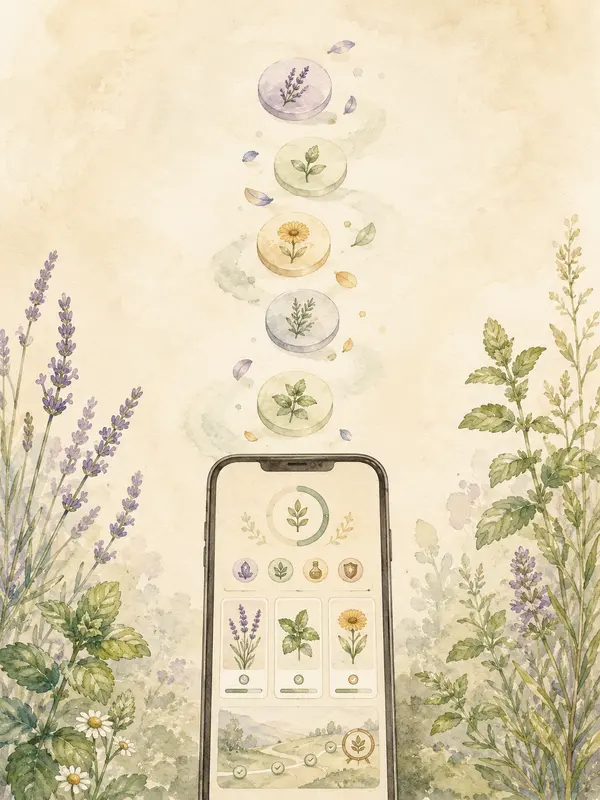
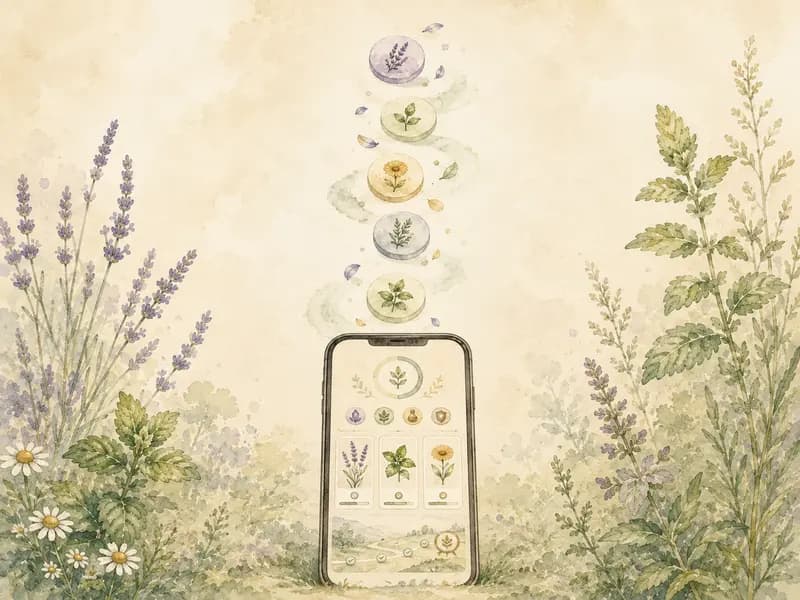
Learning herbalism should not feel like a major exam. Many beginners try to absorb too much information at once: Latin names, traditional uses, preparations, and safety precautions. The problem is that memory works better when learning is divided into small steps and repeated over time. That is the same logic behind modern learning apps: practice a little, often, with motivating progress.
Spaced repetition helps you remember longer
Spaced repetition means reviewing an idea several times, but at separate moments. Instead of studying one plant for an hour and then forgetting it, you review it today, tomorrow, and then again a few days later. A meta-analysis by Cepeda and colleagues examined 317 experiments on this principle of distributed practice.
This method is useful because it respects the natural way memory works. Kang explains that hundreds of studies in cognitive psychology show that reviewing information over time creates more durable learning than grouping everything into one large study session.
The same idea appears in language learning apps. Researchers connected to Duolingo developed a spaced repetition model that can estimate when a word or concept is likely to be forgotten, so a review can be suggested at the right time. For herbalism, the same principle can apply to plants, images, uses, and safety precautions.
Gamification makes practice feel more natural
Gamification uses game-like elements in learning: levels, progress, rewards, daily streaks, characters, goals, and small wins. A meta-analysis by Sailer and Homner found positive effects of gamification on cognitive outcomes, motivation, and learning behaviors, although the effects depend on the quality of the design.
The goal is not to turn herbalism into a simple game. The goal is to make repetition feel less heavy. When someone sees progress, unlocks a plant, or completes a short lesson, they have more reasons to come back the next day.
That is the idea behind Vervain: Herbalism & Plants. Instead of learning herbalism like a school subject, the user moves forward like in a language app: one plant, one image, one idea, one review. Little by little, they build their plant vocabulary without feeling buried under too much information.