
I. The guardian of Celtic secrets
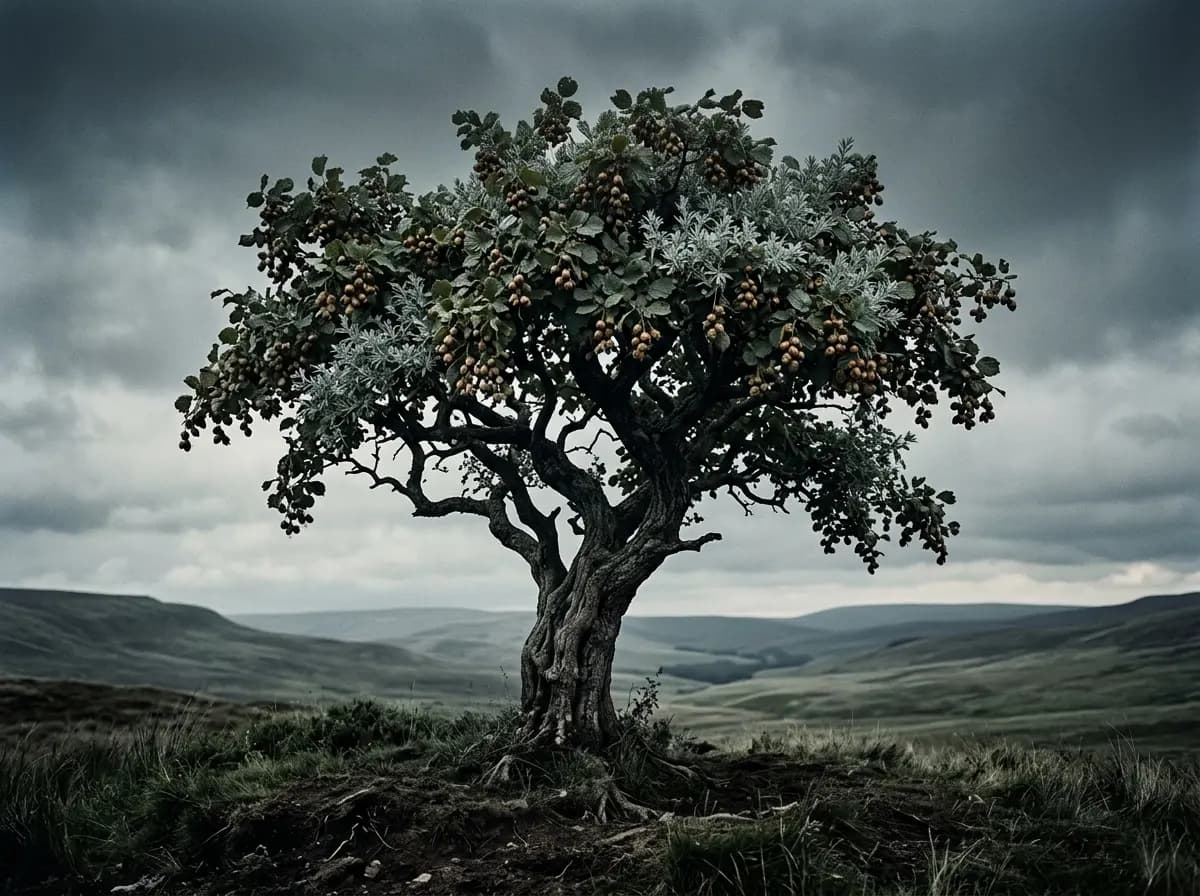
In the sacred forest of the druids, the hazel tree (Corylus avellana) held a privileged place. The ninth tree of the ogham alphabet under the name Coll, it was considered the vessel of wisdom and poetic inspiration. Bards did not approach it lightly: people believed that spirits of knowledge dwelled in its branches and that eating nine hazelnuts before a poetry contest ensured victory. The druids taught that hazel grew at the crossroads of worlds, where the boundaries between the visible and invisible grew thin.
Celtic folklore is filled with stories in which hazel serves as a refuge and guide. In some Welsh tales, the goddess of abundance hid her treasures beneath a hazel tree, and anyone who found a golden hazelnut on the ground could hope for a year of fertility. Closer to our time, the tradition of hazel divining rods has endured for centuries: the tree, said to be naturally drawn to underground springs, was believed to share its secrets with those who knew how to listen. Even the hazelnut itself carried a magical charge. Kept in a pocket, it offered protection from snakes and malicious gossip. Hung above the door of a home, it ensured the household’s fertility and kept lightning away.
In Norse mythology, although Yggdrasil is often described as an ash, hazel also appears as a world tree, an axis between realms. Ratatosk, the squirrel who runs up and down carrying messages between the eagle and the dragon, may well have nibbled a few sacred hazelnuts between missions. For hazel is never merely a tree: it is a messenger, a bridge between the nourishing earth and the inspired sky.
II. The harvest and the gold of the woods
The hazelnut harvest begins in late summer, when the greenish husks start to turn yellow and open like brown paper flowers. If you are fortunate enough to live near woodland, you know this silent race against the squirrels. The secret is to gather the nuts before they touch damp ground, or to dry them quickly if they do. An old trick is to shake the branches with a long stick early in the morning, while the remaining dew keeps the nuts from scattering too far.
There are two ways to preserve them for several months. The simplest is air-drying. Spread the hazelnuts in a thin layer in a dry, well-ventilated place away from direct light. After two or three weeks, the shell becomes brittle and the kernel develops a more concentrated flavour. The second, more rustic method is to dry them in the oven at a low temperature (50°C) for one hour to kill possible larvae and speed up the process. Once thoroughly dry, store them in airtight glass jars away from heat. If you would like to shell them for later, one small trick is to place them in a 180°C oven for a few minutes: the heat slightly splits the shells and makes the task easier.
But the true treasure of the hazel lies in what you make from it. Here is a simple and irresistible ancestral recipe for homemade praline:
- Roast 200g of shelled hazelnuts in the oven (160°C, 10 minutes), until they release their characteristic aroma.
- Make a dry caramel with 150g of sugar in a saucepan, without stirring, until it reaches a golden amber colour.
- Pour the hot hazelnuts into the caramel, mix quickly with a wooden spatula, then spread the mixture onto parchment paper.
- Allow it to cool completely, then crush it with a mortar and pestle or blend it finely until you obtain a smooth praline paste.
This paste keeps for weeks in the refrigerator and transforms any morning coffee into a ritual of abundance. You can also use it to fill chocolates or enrich a tart dough.

Vervain — In season with nature
Never miss hazelnut season again.
Wild harvest calendars and seasonal recipes guide you step by step, from forest to table.
III. The wisdom of roots
Modern herbalism sometimes tends to forget that behind every plant lies a personality, a history, and a character. Hazel is no exception. Its leaves, gathered in spring while they are still tender and downy, are used in mother tinctures with astringent properties, useful in skin care and gargles. Its bark, used with care by experienced herbalists, was once applied as a poultice. But beyond its chemical virtues, it is the tree in its entirety that heals and nourishes.
Returning to hazel means returning to a forgotten form of rural intelligence: one that knows a good harvest depends not only on the weather but also on the respect shown to the tree. It means understanding that abundance is not accumulation, but a patient and generous cycle. The hazel offers its fruit every year without exhausting itself, provided it is given time to regenerate and we never take more than we need.
In our urban and digital lives, this tree offers us a profound lesson in humility. Wisdom is not always found in books or on screens: sometimes it hides beneath a wrinkled shell, in the hollow of a hand that knows how to wait for the right moment. The next time you encounter a twisted hazel at the edge of a forest, stop. Pick up a hazelnut, crack it between your fingers, and taste it slowly. There, in the palm of your hand, you will hold centuries of patience, generosity, and well-kept secrets.
An article written for those who know that true wealth grows on trees.
Selected references
Oregon State University Extension Service.
Harvesting, Handling and Storing Nuts from the Home Orchard(cited via The Oregonian/OregonLive, 2019). Recommendations from horticulturist Ross Penhallegon on harvesting, drying, and storing hazelnuts at home.
Encyclopædia Britannica. Yggdrasil. A reference article on the cosmic tree of Norse mythology, including the description of Ratatosk in the Poetic Edda and Snorri Sturluson’s Prose Edda.
Wikipedia and primary Norse sources (2024).
Ratatoskr. A compilation of the squirrel Ratatosk’s attestations in the Grímnismál — Poetic Edda — and the Gylfaginning — Snorri Sturluson’s Prose Edda.
Cloud Forests Ireland (2026).
Introduction to the Hazel Tree. A presentation of hazel in Irish heritage: the mythology of the Salmon of Knowledge, the ogham alphabet — Coll — and the archaeology of hazelnuts in Mesolithic Ireland.
The Druid’s Garden (2021).
Sacred Trees in the Americas: American Hazel (Corylus americana) — Magic, Ecology, and Sacred Uses
. An analysis of hazel in Celtic druidic traditions, divining rods, and the Salmon of Wisdom cycle.
Note on oral folklore: Welsh legends of divining rods and tales of golden hazelnuts are presented as oral traditions recorded by nineteenth-century folklorists. For further reading: James George Frazer, The Golden Bough, and Alexander Carmichael, Carmina Gadelica.