
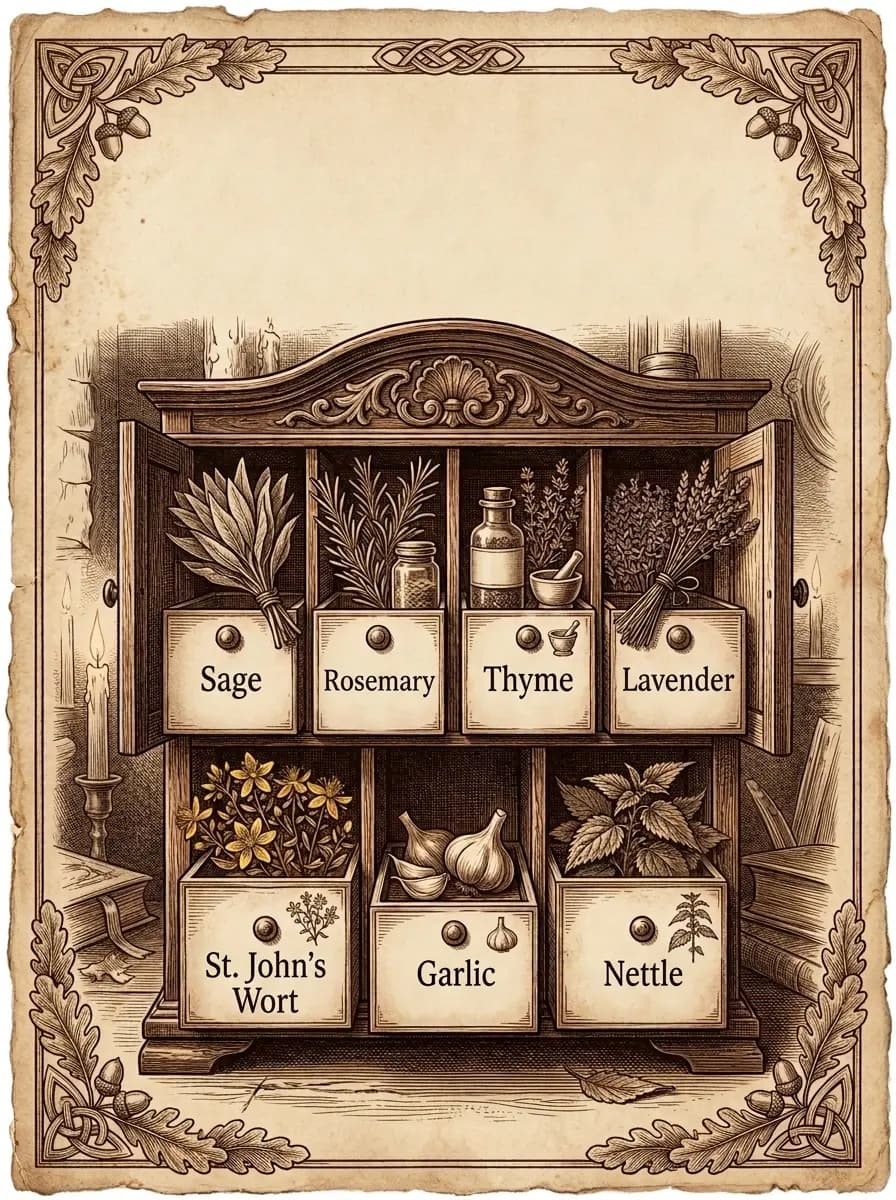
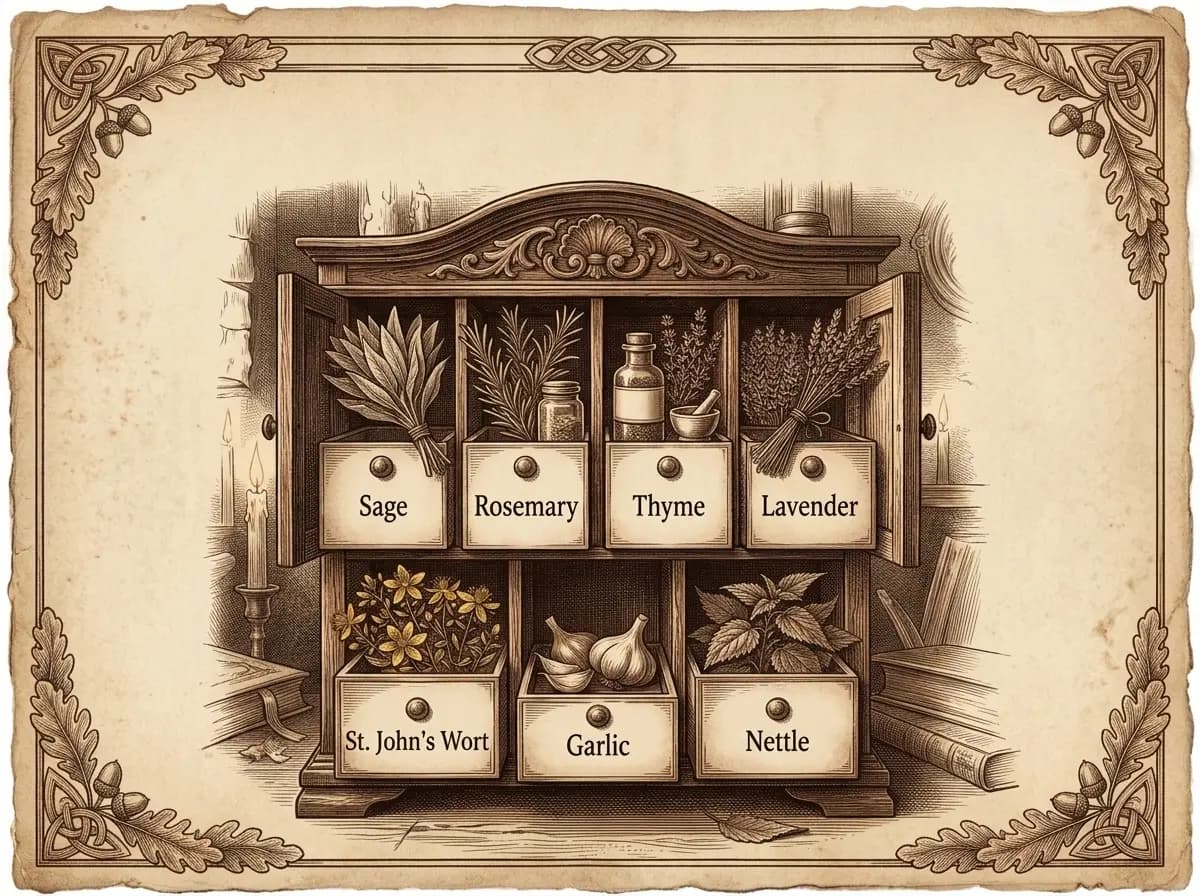
Before pumpkins and candy, Halloween was called Samhain—and protection did not come from plastic decorations. It came from plants. But protecting a house is not a single act: it is a journey. From the outside in. From the earth toward the dream.
Here are seven herbs which, taken in the order our ancestors used them, trace an invisible path. Each guards one stage. Together, they form a sealed spiral. [1]
1. Nettle: the weight of boundaries
Before the house even begins, there is the boundary. Not a clear line, but a weight—a place where the known world grows heavy, where fear takes root, where dark magic prowls. This is where nettle (Urtica dioica) stood guard. Planted at the far edges of the land, it did not repel with light: it held fast through density. Its stinging hairs are like mineral chains—each sting a weight that says: this is where the known world ends.
Among the Celts, stands of nettle signalled that fairies lived nearby; yet nettle was also used as protection against their magic and against dark magic. In the Anglo-Saxon world, the famous Nine Herbs Charm—a pagan spell preserved in a tenth-century manuscript—used nettle against “elf-shot” and “flying venom,” mysterious afflictions the ancients attributed to the arrows of invisible beings. An old farmer's charm also instructed the bearer to gather seven nettle branches, bind them with seven knots, and carry them to ward off misfortune—as though time itself, twisting back upon itself, could be knotted and mastered.
Despite its threatening appearance, this guardian is a treasure trove of benefits: diuretic, anti-inflammatory, and rich in iron and vitamins. It purifies the blood, relieves allergies, and strengthens the body. A sentinel that stings… but also heals. [13] [14]
Fear is held at the boundary. The threshold may open.
2. Garlic: the expanding seal
A boundary without a door is only an empty promise. Between outside and inside lies the threshold—the narrow passage where one decides who may cross. Garlic (Allium sativum) was rubbed on doorposts to create a living barrier. But garlic does not repel through force: it saturates. It spreads, permeates, and fills the air with its scent like a metal that coats and preserves. This is the law of the threshold: not violence, but the authority of fullness.
The bond between garlic and vampires was not invented by Bram Stoker. It reaches back to the Slavic folklore of the Balkans, where the word “vampire” emerged around 1725 and the Great Vampire Epidemic of 1725–1755 saw villagers exhume their dead and subject them to ancestral rites. Stakes were driven through the hearts of suspected revenants, their bodies were packed with onions and incense, and their corpses were covered with garlic. In Romania, the strigoi—the undead who haunt the living—could tolerate neither garlic nor incense. A doorway rubbed with garlic became an extension of the sealed coffin: a boundary only the living could cross, sealed by ancient law.
A powerful natural antibiotic, antihypertensive, and anticoagulant, its allicin fights infections and strengthens the immune system. Vampires may not fear garlic, but microbes do. [11] [12]
The threshold is saturated with protection. The interior becomes a sanctuary.
Download our gamified herbalism quiz app! True or false, multiple-choice questions on medicinal properties and active compounds—test your knowledge of mint, calendula, thyme, and many more plants.
Discover Vervain3. Sage: the red-hot iron
Once the door is closed, the place must be made clean—not in the housekeeping sense, but in the ancient one: making emptiness habitable. Sage was burned as a fumigation so that the air itself might change its nature. And sage does not purify gently: it burns. Its smoke is a weapon of fire passing through space, a red-hot iron cauterizing the unseen.
Its name comes from the Latin salvare: to save, to heal. [18] Among several Indigenous peoples of North America, sage was burned in purification ceremonies to cleanse people, objects, and places of negative influences. Its smoke travelled through the space and reached into every corner. Purification through combat. [19]
The truth? When burned, sage releases essential oils with antiseptic and antibacterial properties. It purifies the air, aids digestion, and soothes irritated throats. Spirits may not have liked its scent. Microbes, however, flee from it without a shadow of a doubt. [2] [3]
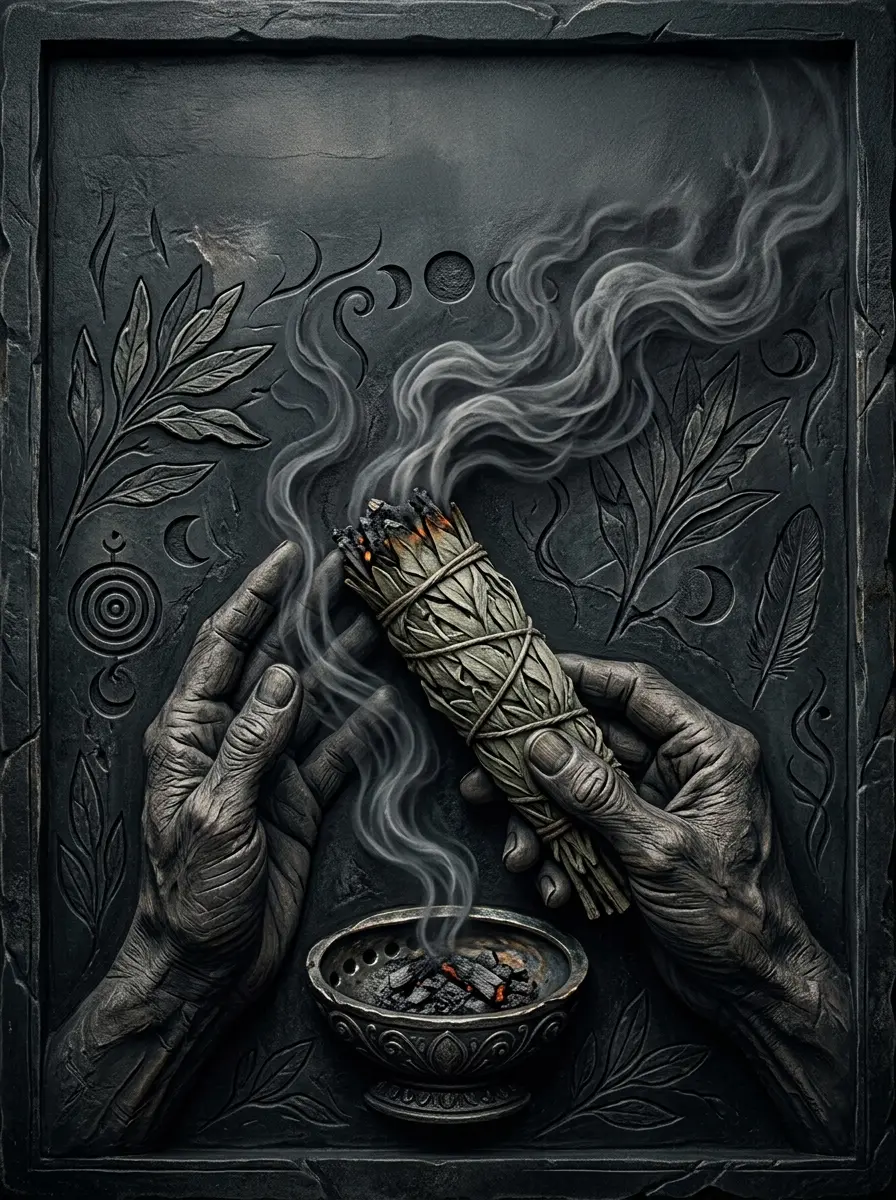
The air has been purified by fire. Silence can now hold memory.
4. Rosemary: incorruptible gold
In a purified house, silence is not empty: it is inhabited. The absent have their place within it. Rosemary (Rosmarinus officinalis) preserved what time erases—memory. And memory, when true, is a metal that does not rust: it endures.
In ancient Greece and Rome, it accompanied funeral rites and could be placed in the hands of the dead as a symbol of remembrance and enduring affection. Greek students wove sprigs of rosemary into their hair in the hope of sharpening their memory. Fixing the light of what once was, so that it might illuminate what is. [20]
And science agrees: a recognized cognitive stimulant, it improves concentration, supports blood circulation, and its antioxidants protect the brain. The ancients associated it with the dead because it preserved memory—and biology confirms their intuition. [4] [5]
What is precious has been preserved. The watcher is not alone.
5. Thyme: the heart in measure
The night of Samhain is not made for sleep. It is made for keeping watch. And keeping watch takes courage—not the courage of battle, but that of patience and a tended flame. Thyme does not shout of courage: it carries it in measure, like a warmth that sustains without burning.
For the ancient Greeks, thyme represented vital energy, spirit, and bravery. Its name may come from thymos, courage or inner strength. Another origin is also possible: thymiama, a substance burned as incense. In either case, thyme joined smoke to courage, like an invisible strength breathed in before facing the night. [20]
Thyme (Thymus vulgaris) contains thymol, a powerful natural antiseptic. It tones the body, relieves respiratory infections, and stimulates the immune system. Courage, certainly—but above all, a pocket pharmacy. [6]
The heart beats in measure. The night approaches its zenith.
6. St. John's wort: the messenger of light
At the heart of the night, when the veil is at its thinnest, light is needed. Not the light of fire—the light that passes, travels, and never settles. St. John's wort (Hypericum perforatum) was hung in homes as a protective plant meant to drive away harmful influences. It is spirit made plant: the only thing able to be here and elsewhere at once.
It was gathered around St. John's Day, when summer reached the height of its light. Its yellow flowers became a talisman against witches, evil spirits, and misfortune. Light borrowed from the longest days to cross the darkest nights. [21]
It is a documented natural antidepressant. It regulates mood, relieves anxiety, and possesses anti-inflammatory properties. Protecting the home? Perhaps. Protecting morale? Absolutely. [9] [10]
The light has been carried, not held. Only the crossing to the other shore remains.
7. Lavender: the mirror of sleep
When the vigil is complete, the boundaries held, the threshold sealed, the air purified, the absent honoured, courage summoned, and light preserved—only then does rest arrive. Slipped beneath the pillow, lavender (Lavandula angustifolia) opened the passage into sleep. But it does not project: it reflects. It is the gentle mirror, the calm surface that receives the dream.
Its name comes from the Latin lavare: to wash. For the Romans, it was the plant of the bath—the threshold between labour and rest. English folklore says that lavender beneath the pillow brings “true dreams”—not nightmares, but dreams bearing a message. A medieval legend tells that the Virgin Mary dried the infant Jesus's swaddling clothes on lavender bushes, and that their holy fragrance has lingered ever since. [22]
Recognized for its anxiolytic and sedative properties, it reduces stress, improves sleep quality, and calms overheated nerves. No spirits are needed to understand why people slept better. [7] [8]
The circle is complete. From gravity to weightlessness, from the threshold to the pillow, the house has been transmuted.
Sources and references
National Museum of Ireland.
Traditions and customs of Halloween / Samhain.
European Medicines Agency.
Salviae officinalis folium.
Nautiyal, C. S., Chauhan, P. S., and Nene, Y. L. (2007).
Medicinal smoke reduces airborne bacteria. Journal of Ethnopharmacology, 114(3), 446–451.
Pengelly, A., et al. (2012).
Short-term study on the effects of rosemary on cognitive function in an elderly population
. Journal of Medicinal Food, 15(1), 10–17.
European Medicines Agency.
Rosmarini folium.
European Medicines Agency.
Assessment report on Thymus vulgaris L. and Thymus zygis L..
European Medicines Agency.
Lavandulae aetheroleum.
Yoo, O., and Park, S.-A. (2023).
Anxiety-Reducing Effects of Lavender Essential Oil Inhalation. Healthcare, 11(22), 2978.
Diocese of Exeter.
Churchyard plants: St John's Wort.
National Center for Complementary and Integrative Health.
St. John's Wort: Usefulness and Safety.
Choo, S., et al. (2020).
Antimicrobial properties of allicin. Journal of Microbiology, 65(3), 451–465.
National Center for Complementary and Integrative Health.
Garlic: Usefulness and Safety.
Bhusal, K. K., et al. (2022).
Nutritional and pharmacological importance of stinging nettle. Heliyon, 8(6), e09717.
European Medicines Agency.
Assessment report on Urtica dioica L. and Urtica urens L..
Lindley, John, and Moore, Thomas (1866).
The Treasury of Botany: A Popular Dictionary of the Vegetable Kingdom
. Longmans, Green and Company.
Royal Botanic Gardens, Kew.
Garden sage — Salvia officinalis.
United States Department of Agriculture, Natural Resources Conservation Service.
Plant Guide: White Sage — Salvia apiana.
J. Paul Getty Museum.
Ancient Herbs in the J. Paul Getty Museum Gardens.
The Metropolitan Museum of Art.
St. John's Wort — Midsomer Magick.
Muséum national d'Histoire naturelle.
Lavande vraie — Lavandula angustifolia.