
1. A scene you know
It's 7:45 p.m. Your youngest won't put on pyjamas. The oldest has lost their stuffed animal for the third time this week. The kitchen still smells of dinner, the ceiling light is too harsh, and you feel that familiar tension settling into your shoulders — the kind that signals another hour of negotiation before the house goes quiet again.
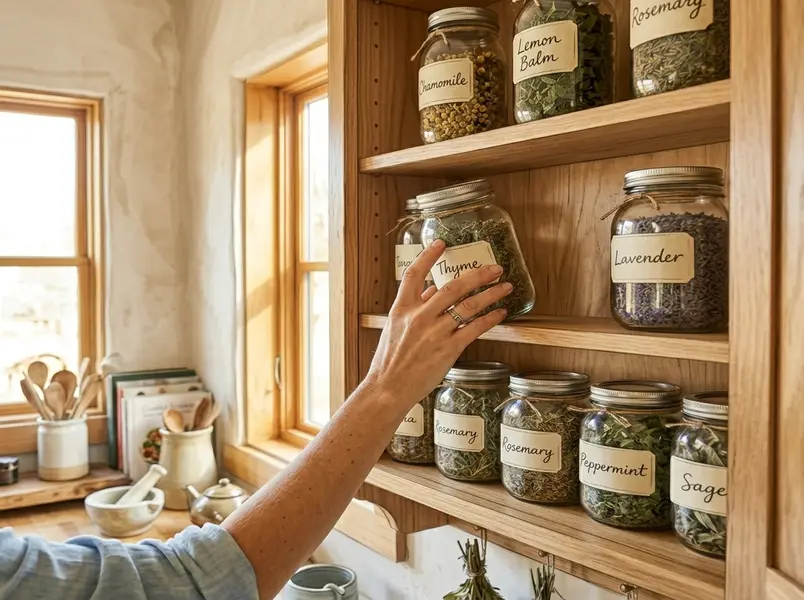
You fill the kettle. It's almost become a reflex. While the water heats, you reach for the jar of chamomile flowers on the second shelf of the cupboard, next to the dried lemon balm you gathered in June. Two pinches into the teapot. Three, if the day was really hard. You pour the simmering water, set the lid on top, and put the timer on eight minutes.
It's not magic. It's not a remedy. It's a gesture — and it's the gesture that changes everything.
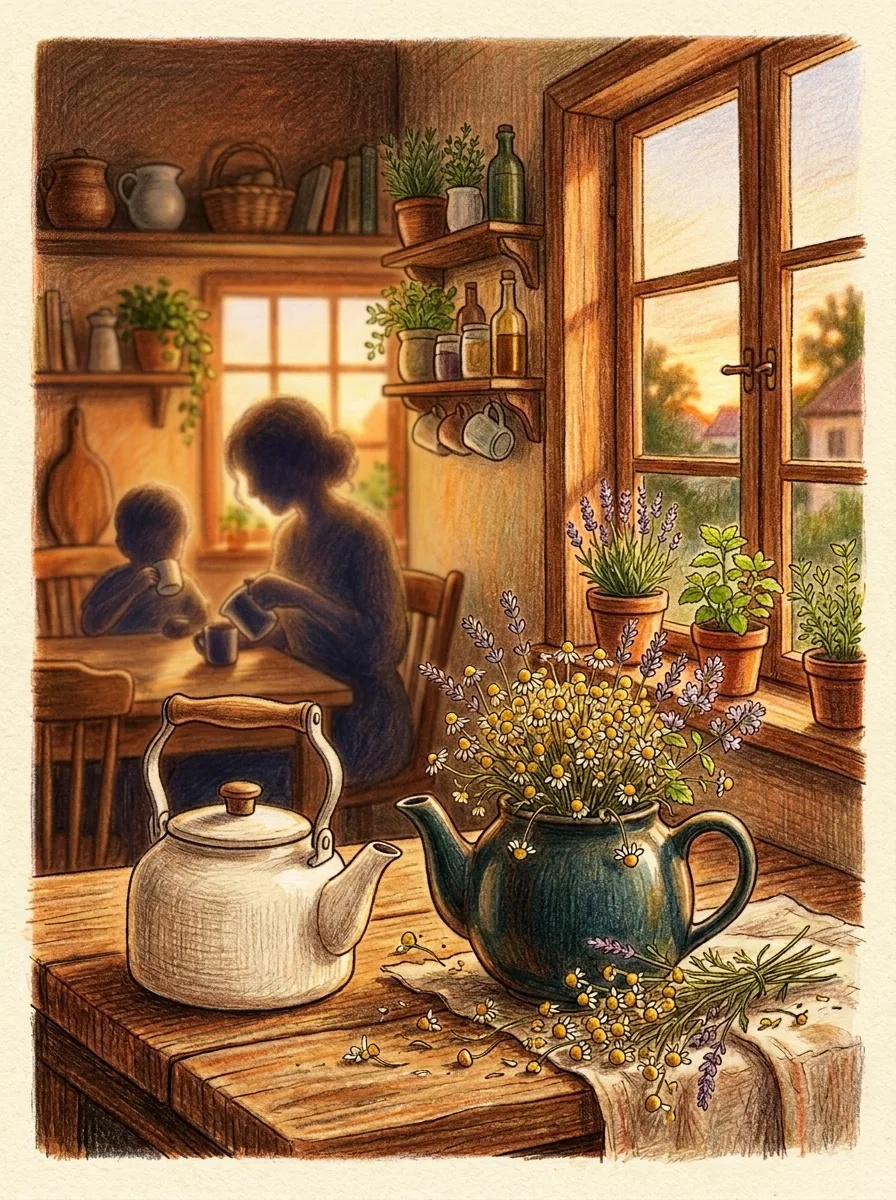
The steeping time becomes an interlude in the evening. You take out three cups: a big one for you, two small ones for the children. You dim the ceiling light and turn on the counter lamp instead. You set the teapot on the coffee table the way you'd set down a lamp.
And something happens.
Your children come and sit down. Not because you ordered them to, not because you raised your voice. Because the light changed. Because it smells of something else. Because you yourself are no longer rushing.
Mothers have been making this gesture for a very, very long time. Not to put their children to sleep — chamomile doesn't have that power, let's be honest. To bring the whole house down a notch. To mark the passage from the restless day to the quieting evening. The plant is only a fragrant pretext.
But what a beautiful pretext.
2. The gesture, tonight
If you want to try tonight, here's what you'll need.
A teapot, ideally glass — so you can watch the flowers open in the water. Otherwise, any teapot will do, and even a large bowl covered with a plate is enough if that's all you have. The gesture matters more than the object.
Dried chamomile flowers, loose, bought from an herbalist or harvested yourself if you grow them. Avoid mass-market tea bags — the chamomile in them is often crushed, aged, and has lost half its fragrance. When you open a good bag of dried chamomile, it should smell of apple and warm hay. That's how you'll recognize a plant that's still alive.
And a little dried lemon balm, for the evenings when chamomile alone isn't enough. Lemon balm has that gentle lemony scent that softens chamomile's slight bitterness and seems, for reasons no one quite knows, to make your shoulders drop.
🌿 The evening tea — how to make it
- 1 tsp chamomile flowers per cup (or 2 pinches of whole flowers)
- ½ tsp dried lemon balm per cup, if you're adding it
Simmering water (around 90°C / 195°F), not boiling — water that's too hot destroys the delicate floral aromas
- 8 minutes, covered
- Strain and serve
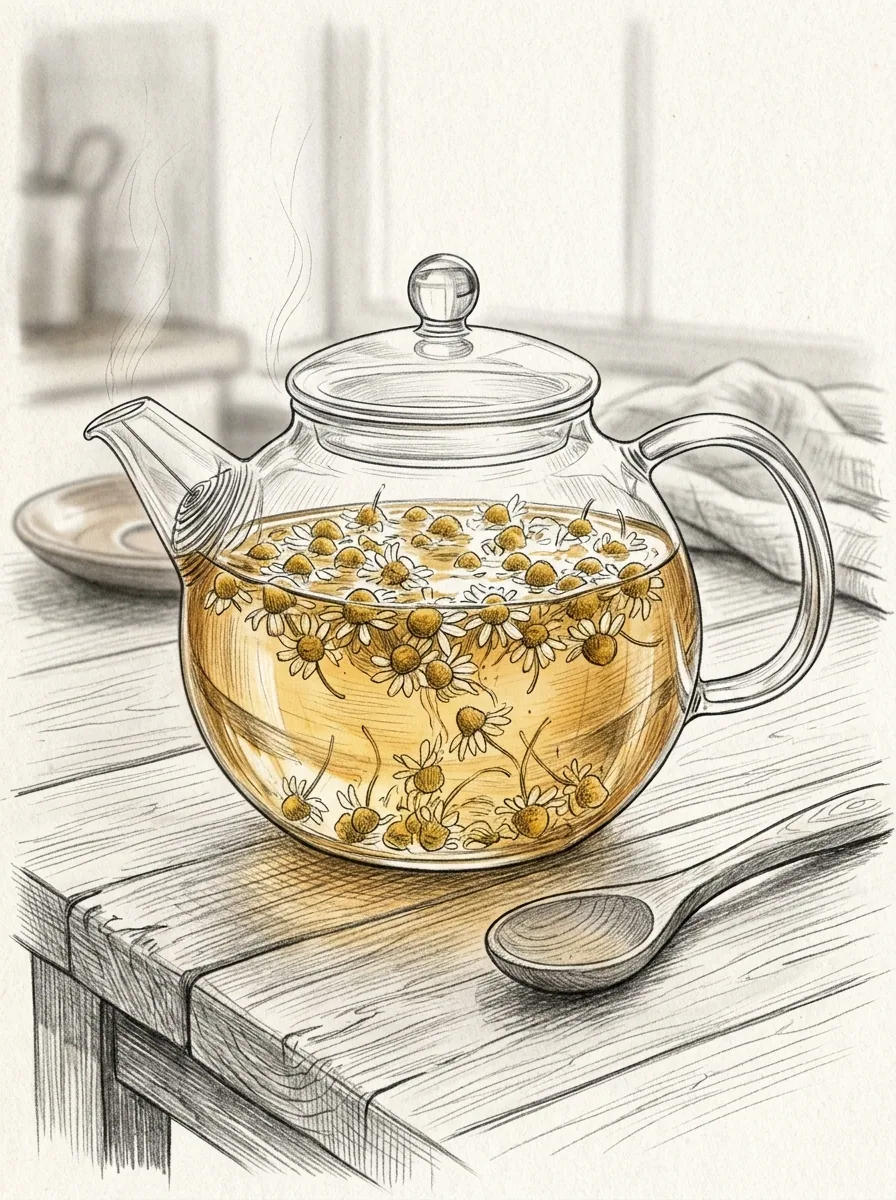
For the children: dilute with a little cold water and serve it lukewarm, in a small cup of their own. Chamomile has a floral, faintly apple-like taste — most children accept it without sugar. If they really resist, a touch of honey (after age one) changes everything.
3. The woman who dared to write
This gesture you're making tonight — a woman was the first to write it down, nearly a thousand years ago. And she paid dearly for it.
The girl who was locked away
In 1106, in the Rhine Valley, an 8-year-old girl is given to a monastery by her family. Her name: Hildegard. At the time, it's the custom — noble families offer one of their daughters to God, the way one pays a tax. Hildegard did not choose.
But Hildegard has a secret. Since she was very small, she has had visions. Flashes of light, images, phrases she doesn't understand. She knows that if she speaks of them, she'll be called mad. Or worse — a witch. So she keeps quiet. For thirty years.
The woman who spoke
She is 42 when she finally decides to speak. She writes to a well-known monk to ask whether her visions come from God or the devil. The monk mentions it to Pope Eugene III. The pope reads. The pope approves.
At 42, Hildegard officially becomes a voice that Rome listens to. For a woman of the 12th century, it's an earthquake.
From then on, she never stops.
What she did
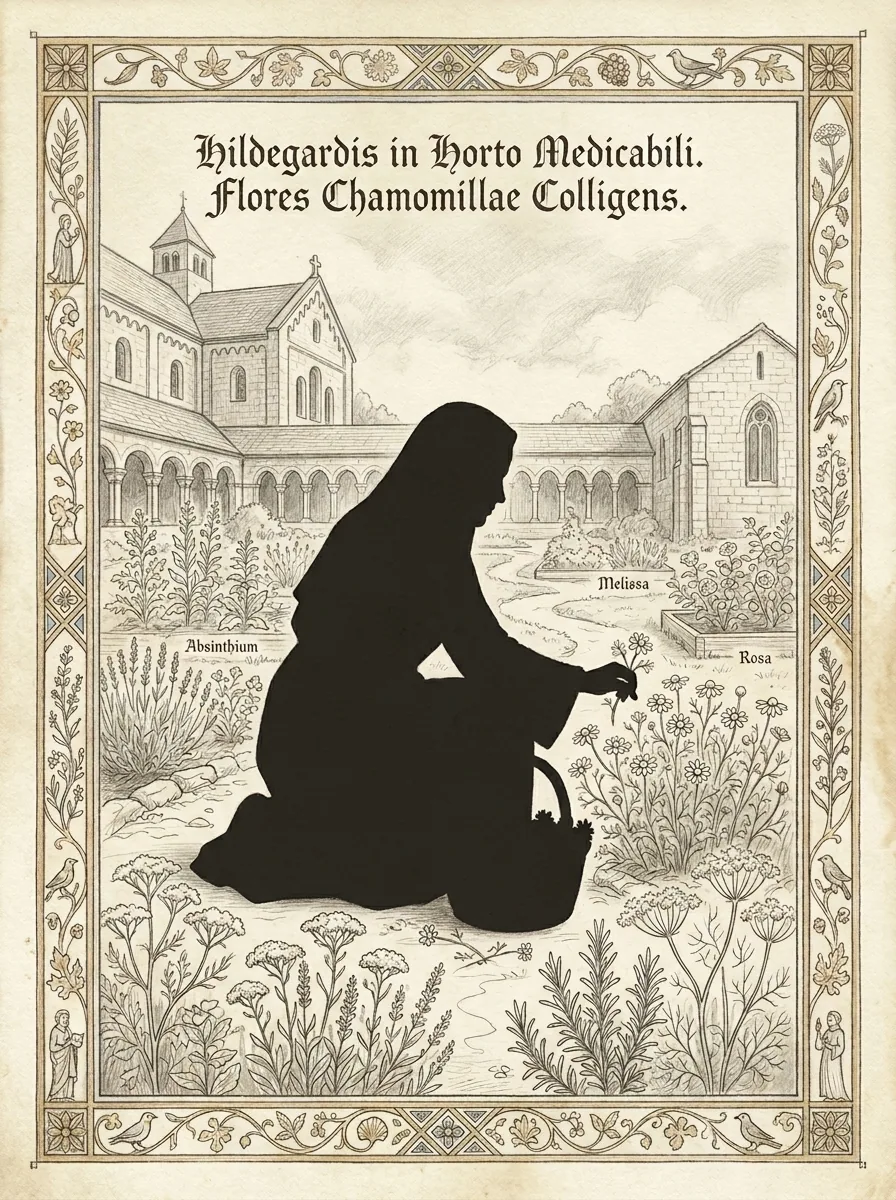
Hildegard writes two medical treatises. The first is called Physica: in it she describes hundreds of plants, their uses, their effects on the body. It's the first time in Europe that a woman sets down in writing what women had always known but no one recorded. Chamomile is there. She describes it as a plant that “comforts restless moods” and “encourages peaceful sleep.”
She also composes more than 70 liturgical chants — we still listen to them on Spotify today. She invents a secret language with its own alphabet. She writes letters to the Emperor of Germany to tell him he's wrong. She preaches in public — which is forbidden to women. She leaves her original abbey after a disagreement with her superior and founds her own community of women elsewhere.
At 81, when she dies, her contemporaries call her “the Sibyl of the Rhine.”
Why this story matters tonight
When you measure your two pinches of chamomile into your teapot, you're making an ordinary gesture. You're making a cup of tea. Three minutes of preparation, eight minutes of waiting.
But no one had written this gesture down before Hildegard. For centuries, women had passed it on from mother to daughter, from neighbor to neighbor, with no manual, no school, no recognition. Hildegard was the first to say: “What we know deserves to be written down.”
And she did it in a world that forbade women from writing about medicine.
A thousand years later, in your kitchen, you no longer need to ask permission. You open your jar. You pour your water. You inherit an unbroken chain of women who kept this knowledge alive — one of whom, in 1150, had the courage to make it into a book.
That's the gesture you're making tonight.
4. Your own cupboard
You're not Hildegard. You don't have a cloister garden, no scribe to copy your recipes, no pope to validate your knowledge.
But you have something she didn't: the right to start small.
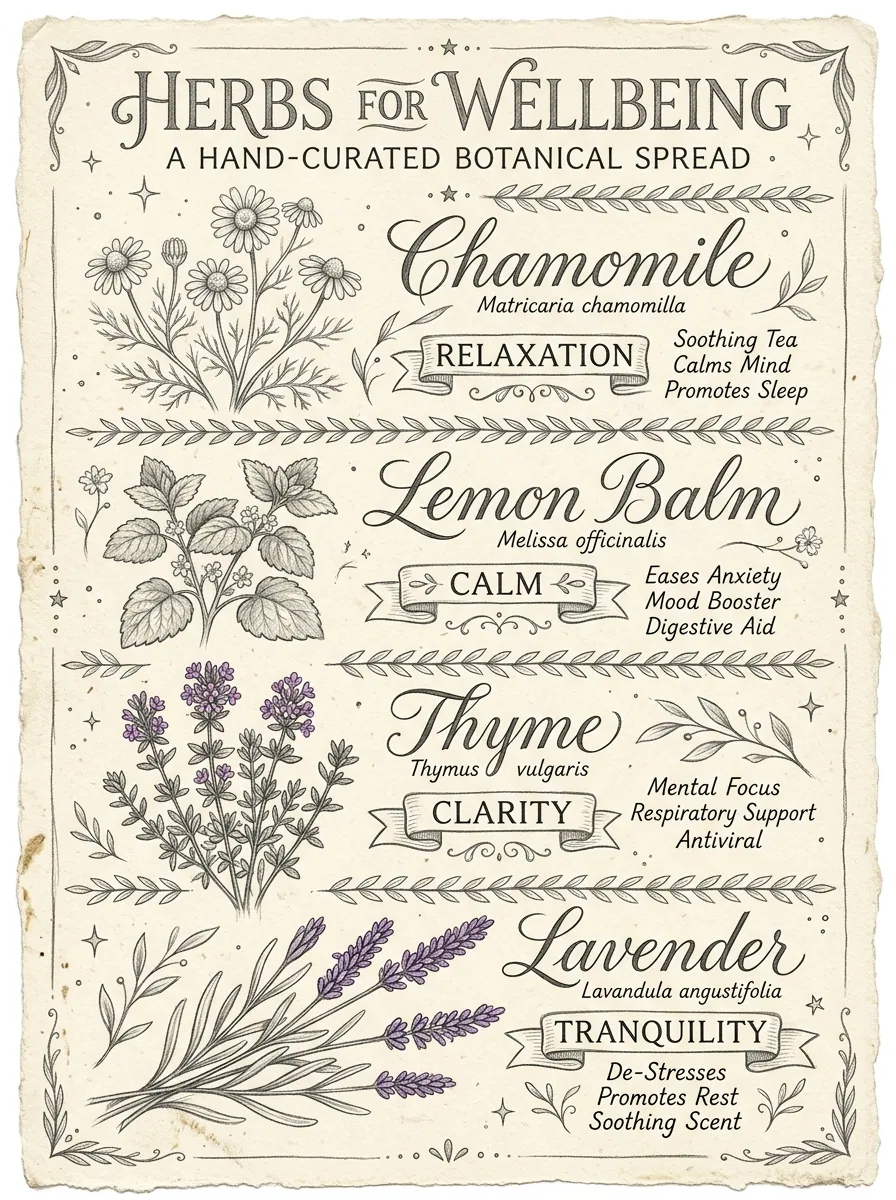
Four plants are enough
An herb cupboard isn't a project. It's a shelf. You don't need twenty jars to feel legitimate. Hildegard took thirty years to write her book — you can set down the first jar this weekend.
Here's where to start:
Chamomile — your evening plant, the one whose story you've just read
Lemon balm — its lemony companion, for the evenings when chamomile alone isn't enough
- Thyme — for winter colds and autumn broths
- Lavender — to scent the linens, warm baths, and lazy weekends
Four jars. Four handwritten labels. One shelf.
That's all you need to begin.
Dried or living
For dried chamomile, lemon balm and lavender, any good neighborhood herbalist will do. Check that the flowers are whole, that they really smell of something, and that the harvest date is written somewhere. A good dried plant keeps for a year. Beyond that, the fragrance fades and you're brewing hay.
But for the herbs you use fresh every day — basil, parsley, chives, rosemary, thyme — things get complicated in winter. In Quebec, in Ontario, across the northern half of the United States, for six months a year, fresh herbs are expensive, travel too far, and end up wilting in a plastic clamshell at the back of the drawer.
There's another way. A living kitchen, where herbs grow within arm's reach, summer and winter alike.
That's exactly what we've built for today's homes.