
I. The Chthonic Portico and the Fracture of Time
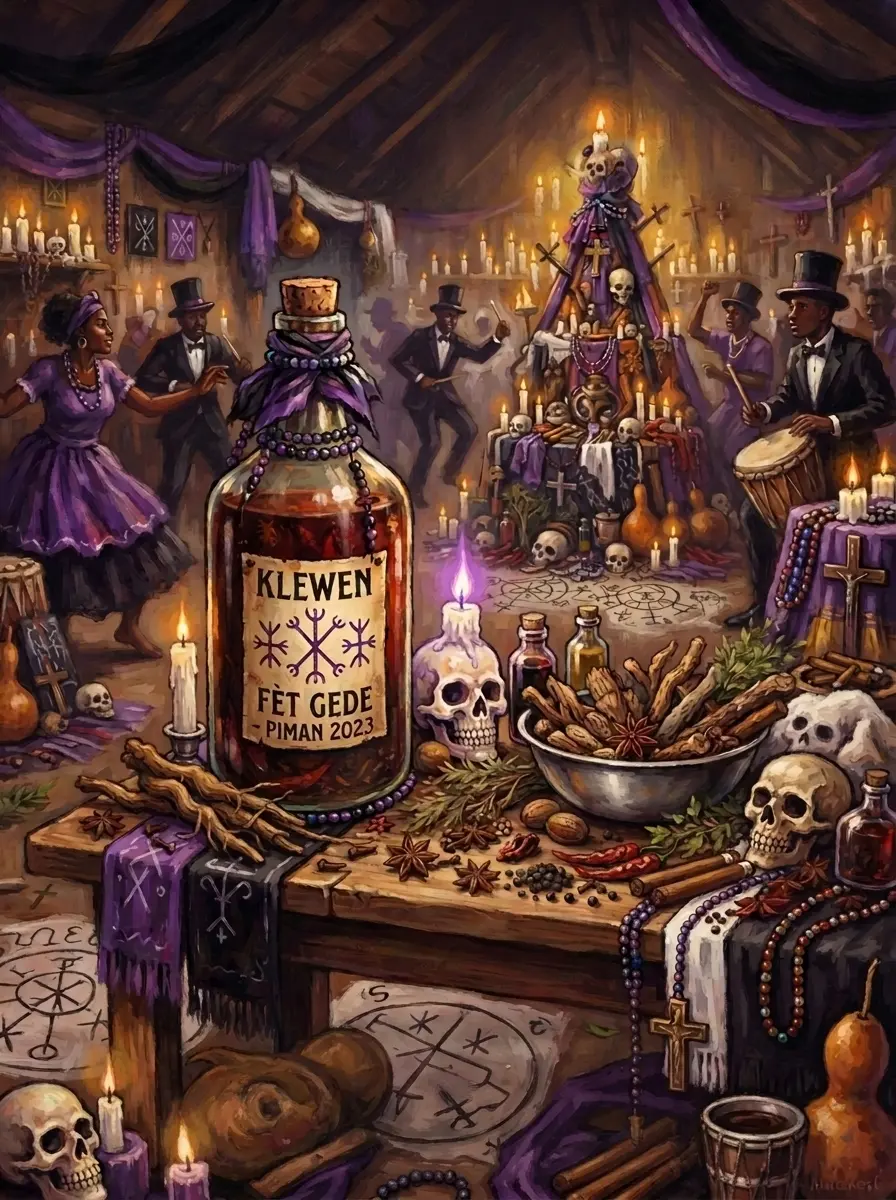
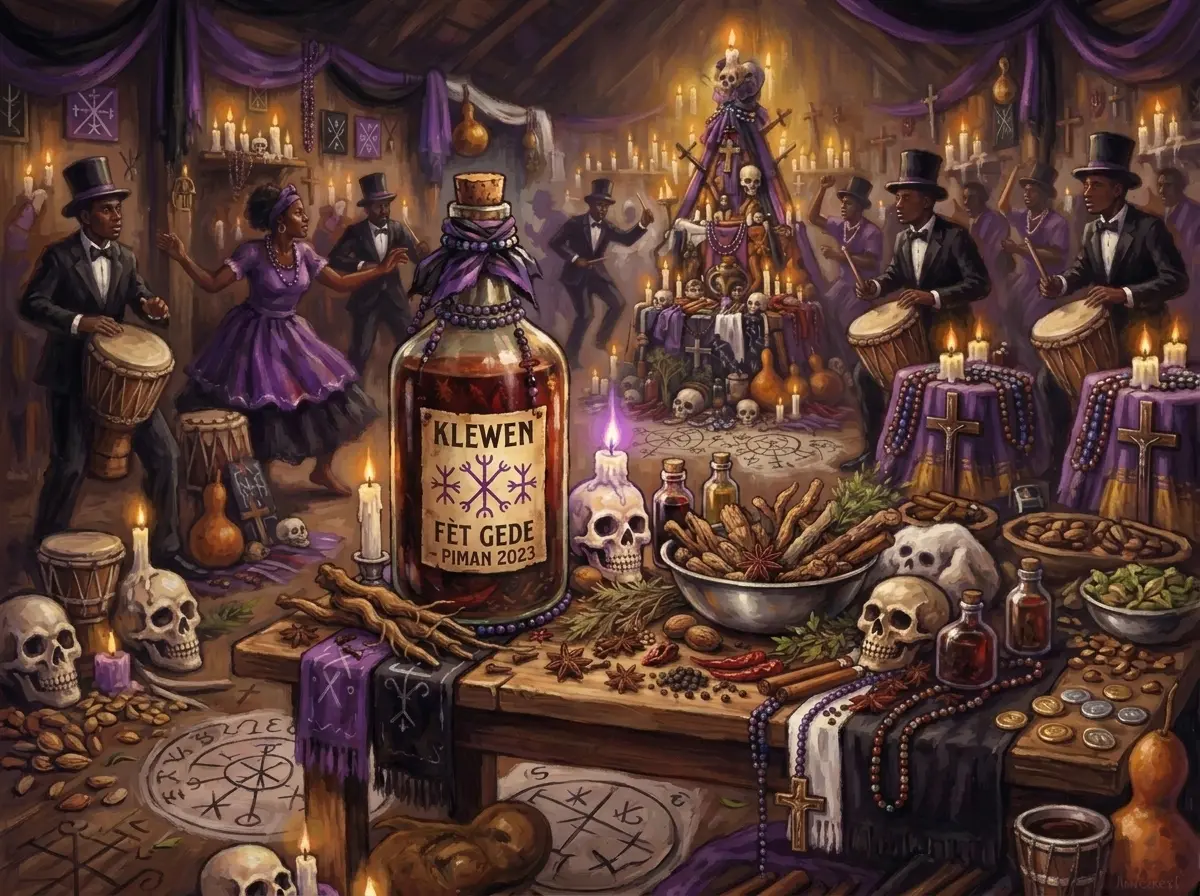
On this first day of November, the gates of Haiti's necropolises do not open onto emptiness or silence, but onto the vibrant density of the in-between. The drum does not beat out a rhythm; it weaves the fabric through which spirits cross the diaphragm of worlds. Laughter, sweat, and trance: Fèt Gede is not a commemoration, but a perpetual actualization of the bond that ties germination to putrefaction. Within this operation, plants are not accessories: they are the conducting threads of this subtle electrodynamics, the mineral and organic mediators through which the invisible becomes palpable. [1]
II. The Gede: Archons of Ambivalence and Sulfur
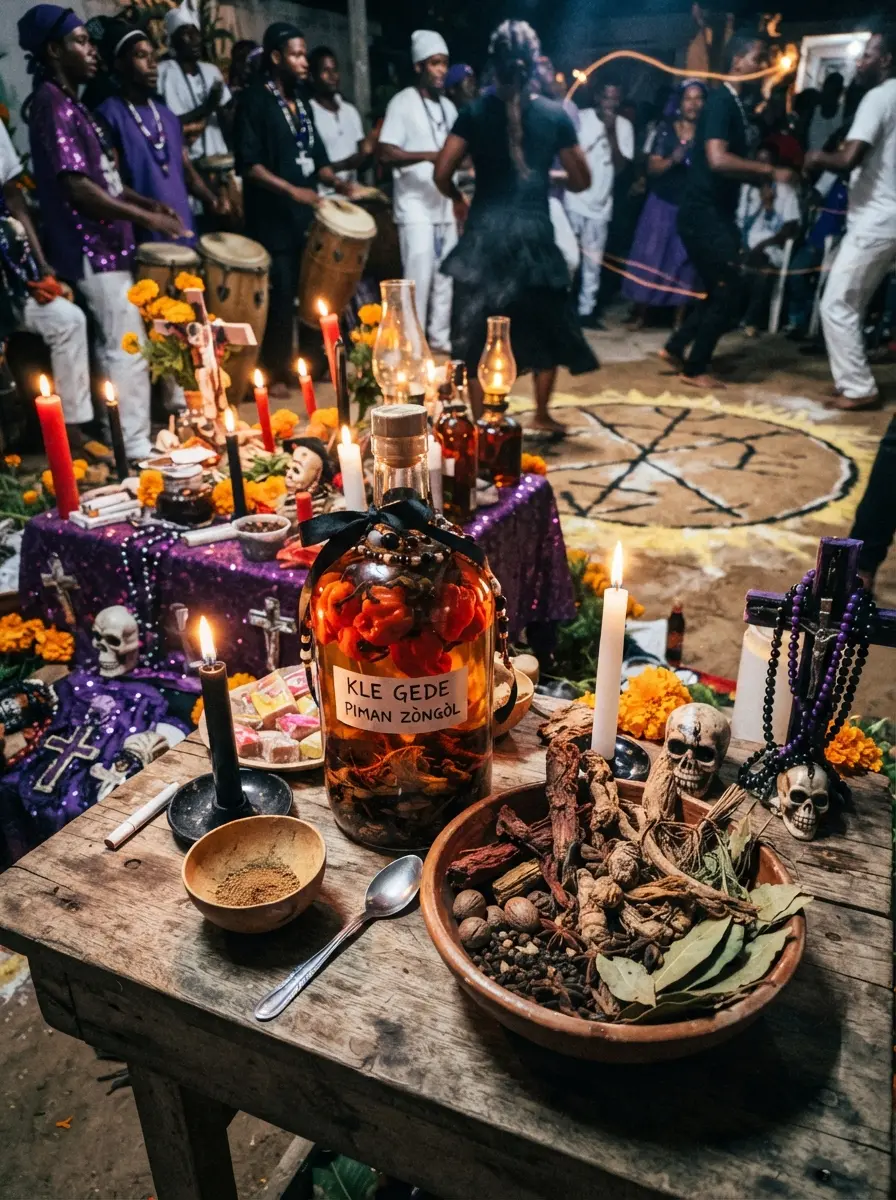
The cohort of Gede spirits, led by Baron Samedi—guardian of the threshold—and Manman Brigit—mistress of the cross's vertical and horizontal axes—embodies the supreme polarity of existence. They are neither mournful nor grotesque; they are the coincidence of opposites (coincidentia oppositorum). Their bawdy humor is but the mask of absolute seriousness; their sensuality, the final embrace before dissolution. When the dancers, dressed in white, black, and purple—the alchemical triad of the fixed, the volatile, and the intermediary—walk the funerary paths, what the profane eye calls folklore is only the surface of an older gesture. Within the logic of ritual, to represent is to make present: the dancers do not simply reenact a scene; they reactivate matter's first movement, that comic and sacred torsion through which death itself begins to dance upon its own nothingness. [1] [2]
III. The Herbarium of Forces: Analogical Pharmacopoeia and Ethereal Tensions
Before the body surrenders to trance, the fluid must be coagulated. The oungan and the manbo are not empirical healers; they are alchemists of the vegetal realm, whose science is a gnosis carried through the roots of time. [3]
Asowosi (Momordica charantia), also known as bitter melon or bitter gourd, does not merely soothe fever; it draws out morbid heat through its sulfurous virtue, fixing the volatile principle of illness within its bitterness. [5]
The calabash tree, planted at the entrance to temples, is no mere tutelary tree; it is the axis mundi, the axial pillar where Legba, lwa of the crossroads, resides. Within it, the blind angle of space becomes an active doorway. [6]
As for the vèvès, those sigillary designs traced upon the ground with coffee or flour, they are but the visible part of a magnetic circuit. The powdered substances from which they are formed are no ornaments; they are the volatile salt, the terrestrial component that anchors and nourishes the electrical discharge of invocation. [6]
The foundational episode of Bois-Caïman in 1791 was no mere political revolt. The religious ceremony that preceded the insurrection was an alchemical rupture of unprecedented magnitude: the oath and offerings became the raw material of a magical bond between the sulfur of the earth and the nitrogen of the stars, breaking the yoke of inertia through the sole force of a covenant of flesh and sap. [4]
IV. The Elixir of Sulfur and the Telluric Offering
Upon the altars dedicated to the Gede, candles and flowers are only the sentinels of a deeper feast. Rum infused with goat pepper, mingled with kleren—that sugarcane spirit, a primordial eau-de-vie—is not a drink. It is the elixir of long life inverted: a concentrate of fixed heat, indispensable for warming wandering spirits in the frost of death. Coffee and roasted corn are poured out, not to feed ghosts, but to establish a resonance between the manducation of the living and the assimilation of the dead. Before entering the sacred enclosure, the petitioner seeks the permission of Papa Gede and Manman Brigit. This is no superfluous courtesy; it is an act of geomancy recognizing that the boundary between passage and ending is merely an illusion of perspective. [1] [2]
V. Apotheosis: The Eternal Return, Danced
From asowosi to pepper, from the calabash tree to corn, Haitian nature unfolds the full measure of its theurgic virtue. Each plant heals, but it heals by virtue of a hidden correspondence with the cosmic humors. Fèt Gede is therefore no festival of the dead in the sorrowful sense of the term; it is a liturgy of incubation. When bodies dance to exhaustion, they imitate the movement of seeds beneath the earth: decomposing so that they may be composed anew. Death is not an ending here, but a reversal of polarity, the laughter of the Void before Time. And in that laughter, borne by spices and roots, all the magic of the world finds its fulfillment: making the tomb a cradle, and grief a vibrant eternity.
To carry the meditation further, whenever the original article mentions a symptom (fever, protection) or a function (guiding, nourishing), ask yourself: “Which universal principle—Sulfur, Salt, Mercury, Axis, Polarity—does this plant or gesture crystallize?” You will then see Vodou not as a religion, but as sacred physics applied.
Sources and references
Visit Haiti.
Fèt Gede — the Haitian Day of the Dead.
Smarthistory.
Antoine Oleyant, Guedeh.
Wolpert, B. J., et al. (2008).
Plant vermicides of Haitian Vodou show in vitro activity against larval hookworm
.
Hoffmann, L.-F. (1990).
Histoire, mythe et idéologie : la cérémonie du Bois-Caïman.
Thesnor, V., et al. (2024).
Survey on the Traditional Use of Medicinal Herbs in Haiti: A Study on Knowledge, Practices, and Efficacy Prevention
.
Hurbon, L. (2022).
Haitian Vodou. Open Encyclopedia of Anthropology.