
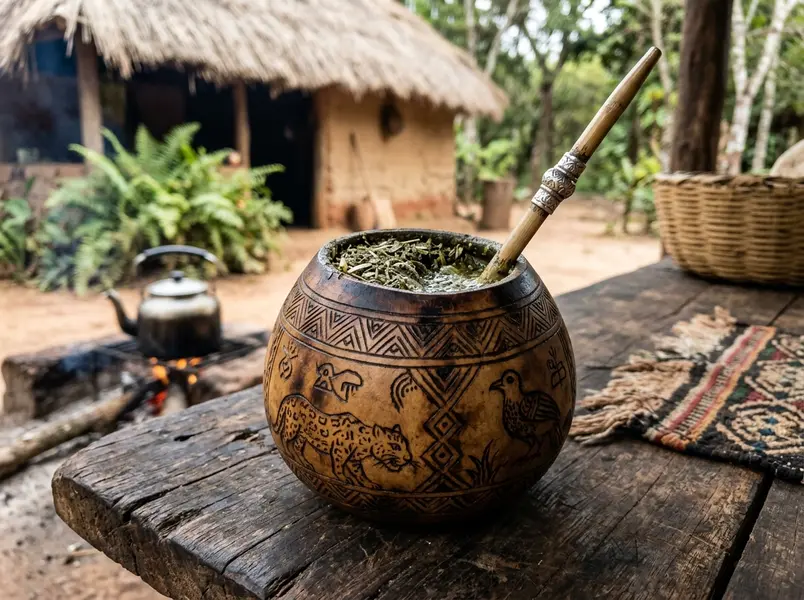
When sweetness was medicine
Long before pharmaceutical laboratories became interested in its leaves, stevia (Stevia rebaudiana) grew quietly in the highlands of Paraguay and Brazil. The Guaraní called it ka'a he'ê, “the sweet herb,” and had known it for generations as the faithful companion of another sacred plant: yerba maté.
This was no accident. Maté alone is bitter, powerful, almost rough. Stevia softened it without sugar, without honey, without anything but its dried leaves. But this union went far beyond taste.
Ingredients
For 1 gourd or 1 cup:
- 2 tbsp dried yerba maté
- 3 to 5 dried stevia leaves, or 1 tsp powdered dried leaves
- 250 ml hot water, not boiling, between 70 and 80 °C
- A traditional gourd (caiguá) or a cup with an herbal filter
Preparation
Mix the yerba maté and stevia leaves directly in the gourd or infuser.
Pour in hot water, but not boiling water: it would burn the aromas of the maté and make the infusion harsh.
Let steep for 4 to 5 minutes.
Stevia releases its sweetness gradually. Do not expect an immediate flavor: it arrives slowly, with a light licorice note at the end.
How to drink it
One cup in the morning, on an empty stomach or with a light meal. The combination of maté's natural caffeine and stevia's sweetness makes it an ideal early-day drink.
The same herbs can be infused two or three times. Stevia keeps its sweetness through several infusions.
Avoid it in the evening: maté contains xanthines, including caffeine and theobromine, which stimulate the central nervous system.
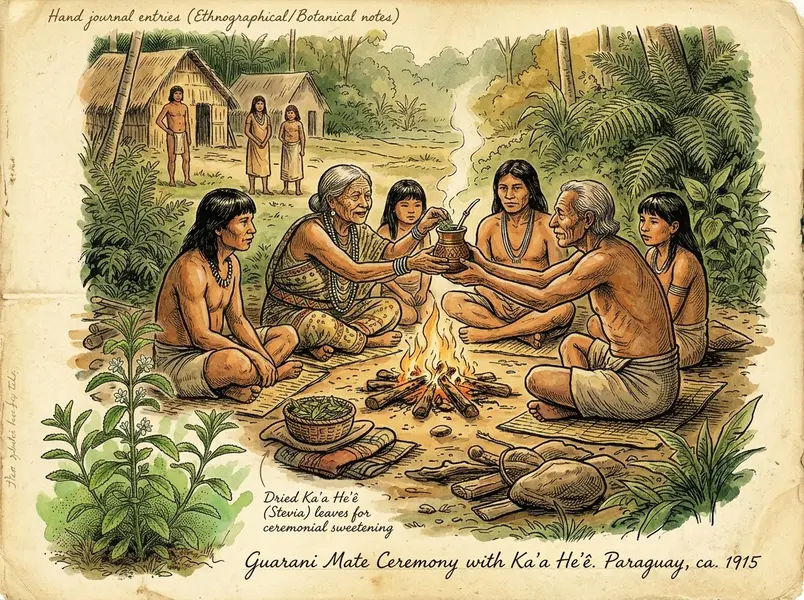
How it was consumed historically
For the Guaraní, maté was not simply a drink. It was the universal vehicle through which medicinal plants were administered: herbs and remedies were added according to the needs of the moment. Stevia found its natural place there, and not only for taste.
The elders observed that some members of the community suffered from a thirst that could never be quenched, persistent fatigue, and frequent urination. They did not know the word “diabetes,” but they knew the sweet plant that seemed to ease those troubles. Likewise, for headaches and dizziness that we would now associate with high blood pressure, or for bringing down fever, stevia leaves found their place in the gourd.
This blend, maté and ka'a he'ê, was not understood as a medical recipe in the strict sense. It was a daily practice, woven into the social and spiritual life of the people. Maté was shared in a circle, a symbol of connection between the living and the ancestors. Adding stevia extended that gesture of collective care.
The Swiss botanist Moisés Santiago Bertoni, who officially classified the plant in 1899, was one of the first Europeans to document these uses: practices that had existed long before his arrival.
Why I also grow stevia hydroponically
Stevia is not only a historical or exotic plant to me. It is also one I grow myself, season after season. In an ideal world, I would grow it outside, with its roots in the soil, under long and steady warmth. But I live in Canada, and Canadian winters have their say.
Hydroponics has become my way of keeping this sweet herb alive all year long. Not out of obligation, but out of a taste for experimentation. There is something fascinating about watching a medicinal plant grow in water, adjusting its nutrition, and understanding what it needs to produce dense, vigorous, aromatic leaves. Each crop becomes another layer of learning.
What I have observed over time: stevia that can be harvested in the middle of January, with a clear sweetness still present in the leaves. By working with nutrition and light, this plant can reach a vigor that is difficult to obtain in ordinary soil during winter. And just before harvest, reducing nitrogen and slightly exposing the roots is enough to push the plant to concentrate more of its aromatic compounds.
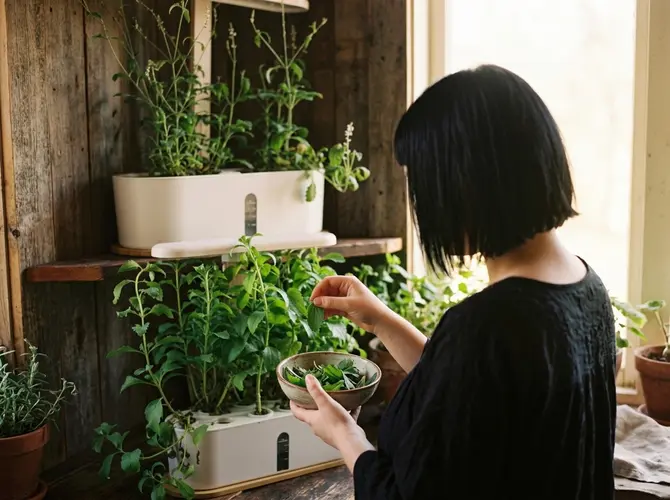
In the upper planter, I am growing 6 vervain plants. In the lower planter, 9 stevia plants.
I do not claim that hydroponics replaces the garden. It extends it. When the garden beds sleep under the snow, the window stays green. And for a plant like stevia, which loves warmth and light, that continuity changes everything.
That, for me, is the point: to connect a plant's history with its living cultivation, observe it closely, learn from it, and never really stop gardening.
This article is cultural and historical in nature. Stevia and maté are not medicines. For any health concern, consult a qualified health professional.